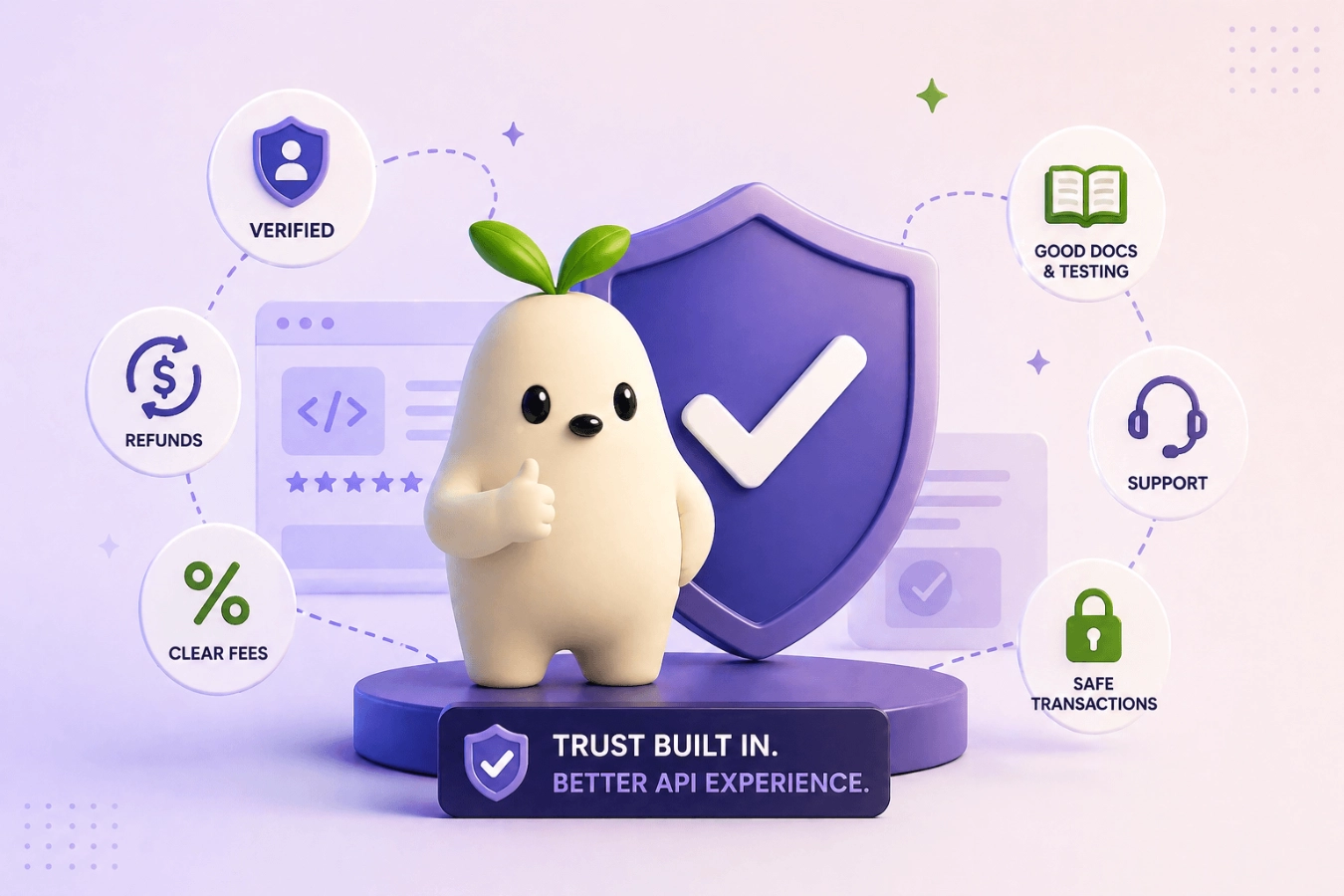
Why trust gives LimitPear an advantage
Trust here is not branding. It is verified listings, refunds, validation, support around the transaction, payouts, and analytics.
LimitPear
LimitPear Editorial

Why trust gives LimitPear an advantage
LimitPear is built around one marketplace problem: if the platform does not protect the buyer and the seller, it is not offering much beyond a directory.
Here, trust is not branding. It is verified listings, refund rules, validation before full publication, support around the transaction, payout handling, and analytics.
For buyers
A buyer needs to know what happens before and after payment. Verified listings reduce the amount of blind checking before the first call. Refund rules show what happens if the API is a bad fit in the first days.
On LimitPear, the refund path is visible: the request has to land within 10 days of purchase, usage has to stay at 10% or less of the quota, and access is removed as soon as the refund request starts. That is a real marketplace rule, not a promise in a help article.
For sellers
A seller needs a reason to publish good APIs on the platform. If solid APIs get buried under fake ones, the seller is doing the work while the marketplace collects the attention.
LimitPear tries to solve that with verified listings, support around the transaction, a 10% commission, and a purchase flow that does not leave the provider alone once money changes hands. That shows up in operations as fewer trust problems pushed back onto the provider by default.
Before the API goes live
Trust also depends on what the platform checks before publication. LimitPear validates with real requests, so the base URL has to be public, the headers and body examples have to work, and the request has to return a 2xx response.
The platform also sends X-LIMITPEAR-PROXY-SECRET on proxied traffic. That lets the provider separate marketplace traffic on the backend instead of guessing where the request came from.
After money changes hands
The trust question does not end at checkout. Payouts go to the PayPal email stored in provider settings, and LimitPear sends them when the settlement month is ready and no refund request is still open.
If a refund is approved, the money goes back through PayPal and that sale is excluded from future payouts. The seller does not need to recover money from the buyer manually.
Analytics
Post-launch visibility is part of the trust layer too. LimitPear gives providers per-API analytics for requests, success rate, status code breakdown, latency, subscriptions, and plan-level activity.
That helps because the seller can see whether the API is actually reliable after publication instead of waiting for support complaints to explain what broke.
Recommendation
Choose LimitPear when the deciding factor is the trust layer around the listing, the purchase, and the first weeks after launch. It is a better fit for teams that care about verification, refund rules, validation, payout handling, and transaction support as one system.
The drawback is reach. Use sell your API or buy an API online through LimitPear when that trust layer is more important than the biggest possible catalog. If raw exposure is the only thing that matters, a broader marketplace can still win.
Build with LimitPear
Turn demand into the next API opportunity
Explore the marketplace, request what is missing, and use the blog as a bridge between ideas and real developer demand.