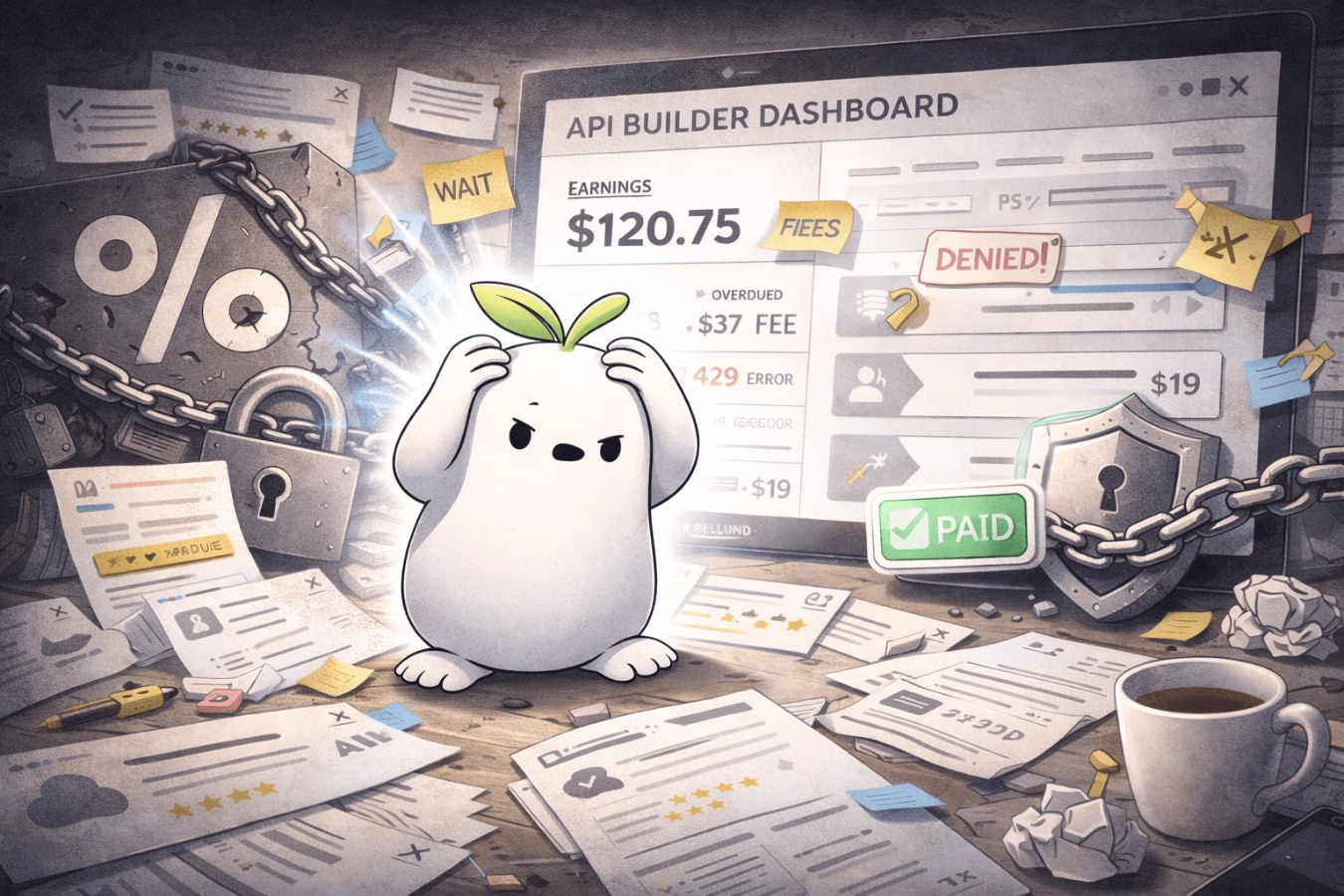
API marketplace fees comparison for sellers in 2026
A comparison page for developers evaluating different marketplace fee models, payout structures, and platform tradeoffs.

Most sellers start an API marketplace fees comparison by looking for one number.
That is understandable, but it is also where a lot of bad decisions start.
Marketplace fees are not just about the platform cut. They are about the full selling setup around that cut and whether the platform actually helps enough to justify it.
So if you are comparing API marketplaces in 2026, the useful question is not only "who takes less?"
It is "which fee model makes the most sense once the whole experience is included?"
Start with the type of fee model
There are a few common patterns:
- flat revenue share
- revenue share plus extra platform friction
- low headline fees with weak marketplace support
- more seller-friendly models built around simpler economics
The headline number matters, but the structure matters more than people think.
A fee model that is easy to understand usually leads to better decisions. A fee model that takes work to decode usually keeps creating problems later.
Compare seller take-home, not just platform language
The point of a marketplace is not to win an argument about percentages.
The point is to help you make money from the API without turning monetization into its own second project.
So compare the real seller take-home experience:
- How much do you keep?
- How easy is it to understand what you keep?
- How much platform work still falls back on you?
- Does the marketplace help enough to justify the fee?
If a platform takes a meaningful cut but still leaves you doing most of the heavy lifting, the effective cost is higher than it looks.
Compare payout friction
This gets ignored too often.
Sellers care about when and how they actually receive money. They care about whether the payout flow feels normal, whether delays are understandable, and whether the platform makes the whole process feel predictable.
Even a reasonable fee can feel bad if the payout side is messy.
That is why "fees comparison" should always include payout friction, not just commission language.
Compare what the platform does for trust
This is where a lot of marketplaces start to separate from each other.
If the platform does not do much for trust, then the seller has to carry more of that burden alone.
That means:
- buyers hesitate more
- listings need more explanation
- weak marketplace reputation hurts good sellers too
A marketplace with a clean trust layer can justify its economics much more easily than one that simply takes a cut and adds noise.
We have written about that directly in why we built LimitPear.
Compare discovery quality too
Fee comparisons often act like sellers only care about cost.
That is not true.
Sellers care about whether the marketplace can actually help people find the API.
If discovery is weak, a lower fee does not save the model. You are still paying with lost visibility, lost momentum, and slower feedback.
In other words, a marketplace with bad discovery can be expensive even when the fee looks fine.
Compare how much business stack you still have to carry
This is probably the most important part of the comparison.
Once you start charging for an API, you are not only selling an endpoint. You are dealing with plans, monetization, buyer expectations, and the surrounding infrastructure that makes the listing believable.
If the marketplace really helps with that, the fee may be worth it.
If it does not, then the fee is only one more cost on top of everything else you are still doing yourself.
That is the seller-side problem behind a lot of marketplace frustration, and it is why we wrote how to publish and monetize your API without building the whole business stack.
What to prioritize in a real comparison
If you are evaluating platforms seriously, compare them in this order:
- Fee clarity
- Seller take-home reality
- Payout simplicity
- Trust and verification
- Discovery quality
- How much marketplace work is still pushed back on you
That order usually leads to better decisions than starting with a percentage and stopping there.
Where LimitPear fits in this comparison
LimitPear is built around a simpler seller story.
The goal is not to make a flashy comparison page and pretend every marketplace is the same except for branding. The goal is to make selling APIs feel lighter, clearer, and more trustworthy for both sides.
That is why we think the better comparison is not only fee versus fee.
It is fee model plus trust, payout clarity, discovery, and how much useless weight the platform removes from the process.
Choose the fee model you can trust
The best marketplace fee model is not the one that looks best in a vacuum.
It is the one that still makes sense after you count the whole experience around it.
If the fee is clear, the selling flow is reasonable, and the marketplace actually helps you publish and monetize without adding chaos, that is usually the better platform.
If you want a simpler path for selling APIs, list your API free.