Turn your API into a product, not just an endpoint
A landing page for developers thinking seriously about packaging, selling, and maintaining an API as a real product.
An API becomes much more valuable when it is treated like a product instead of just a technical interface.
That shift sounds simple, but it changes everything.
When you think about your API as a product, you stop asking only whether the endpoint works. You start asking whether the offer is clear, whether the pricing makes sense, whether buyers trust it, and whether the experience around the API is strong enough for someone to pay for it.
That is what API as a product really means.
It is not just about exposing functionality. It is about packaging, positioning, monetization, and long-term usability in a way that feels commercially real.
What changes when an API becomes a product
A raw API can be useful.
A productized API is useful, understandable, purchasable, and maintainable.
That means the conversation expands beyond the technical layer.
Instead of focusing only on requests and responses, you now need to think about:
- who the API is for
- what problem it solves
- how it is packaged
- how buyers evaluate it
- how access is sold
- how trust is built
- how support works over time
This is where many developers realize that building the API was only the first part.
Turning an API into a product means adding the business and operational layer around the technology.
API productization is really about clarity
A lot of APIs never become products because they remain too close to the builder's perspective.
The developer understands the endpoints. The developer understands the architecture. The developer understands the implementation details.
But buyers do not start there.
They want to know:
- what outcome this API helps them achieve
- whether it fits a real workflow
- what they get at each plan level
- why they should trust it
- what it will cost
- whether it feels stable enough to depend on
That is why API productization is largely an exercise in clarity.
Your API should not feel like a private internal tool that happened to be exposed publicly. It should feel like something intentionally designed for users.
The difference between an endpoint and a product
An endpoint answers a technical question.
A product answers a commercial one.
An endpoint says: here is a capability.
A product says: here is a capability, who it is for, why it matters, how it is packaged, what it costs, and why you can trust it.
That difference matters because buyers do not subscribe to abstractions. They subscribe to products that solve real problems in a credible way.
If you want to turn API into product, you need to think beyond implementation and into presentation, positioning, and buyer confidence.
The core parts of an API product
When developers search for productize your API, they are usually trying to understand which pieces matter most.
Here are the big ones.
1. Clear use case
A strong API product solves an obvious problem for a specific kind of user.
If the use case is vague, everything downstream gets harder. Pricing gets harder. Positioning gets harder. Conversion gets harder.
The best API products are easy to describe in plain language.
2. Packaging
A product needs structure.
That often means defining plans, access levels, or commercial boundaries that help buyers understand what they are paying for. Packaging is what turns a technical service into an offer.
Without packaging, the API may still work well, but it is much harder to sell consistently.
3. Pricing
Pricing does more than generate revenue. It signals how the product should be understood.
A serious API product needs pricing that feels intentional, not improvised. Buyers should be able to understand what they are buying and how the offer scales.
4. Trust
Trust is one of the most overlooked parts of API monetization.
People do not just buy features. They buy confidence.
That confidence comes from:
- a credible listing
- a clear explanation
- visible product quality
- a trustworthy marketplace environment
- signals that the API is maintained and commercially real
5. Ongoing operations
Once an API becomes a product, support expectations rise.
Now you are not only maintaining code. You are maintaining a customer-facing offer.
That includes keeping plans clear, maintaining the listing, improving docs, and making sure the product still feels dependable over time.
Why many APIs stall before becoming products
A lot of developers have the technical capability to build something valuable, but the product layer remains unfinished.
Usually that happens for one of three reasons:
- the API is framed only in technical terms
- the commercial packaging is unclear
- the operational burden around monetization feels too heavy
This is where many projects get stuck in between.
They are too advanced to be hobbies, but not yet structured enough to be products.
That middle state is common. It is also fixable.
You do not need to build every piece alone
One reason developers delay API productization is that the surrounding business stack feels bigger than expected.
To fully productize an API on your own, you may end up thinking about:
- listing infrastructure
- pricing presentation
- subscriptions
- access control
- monetization workflows
- payout setup
- trust and verification
- public positioning
That is a lot to carry next to actual product development.
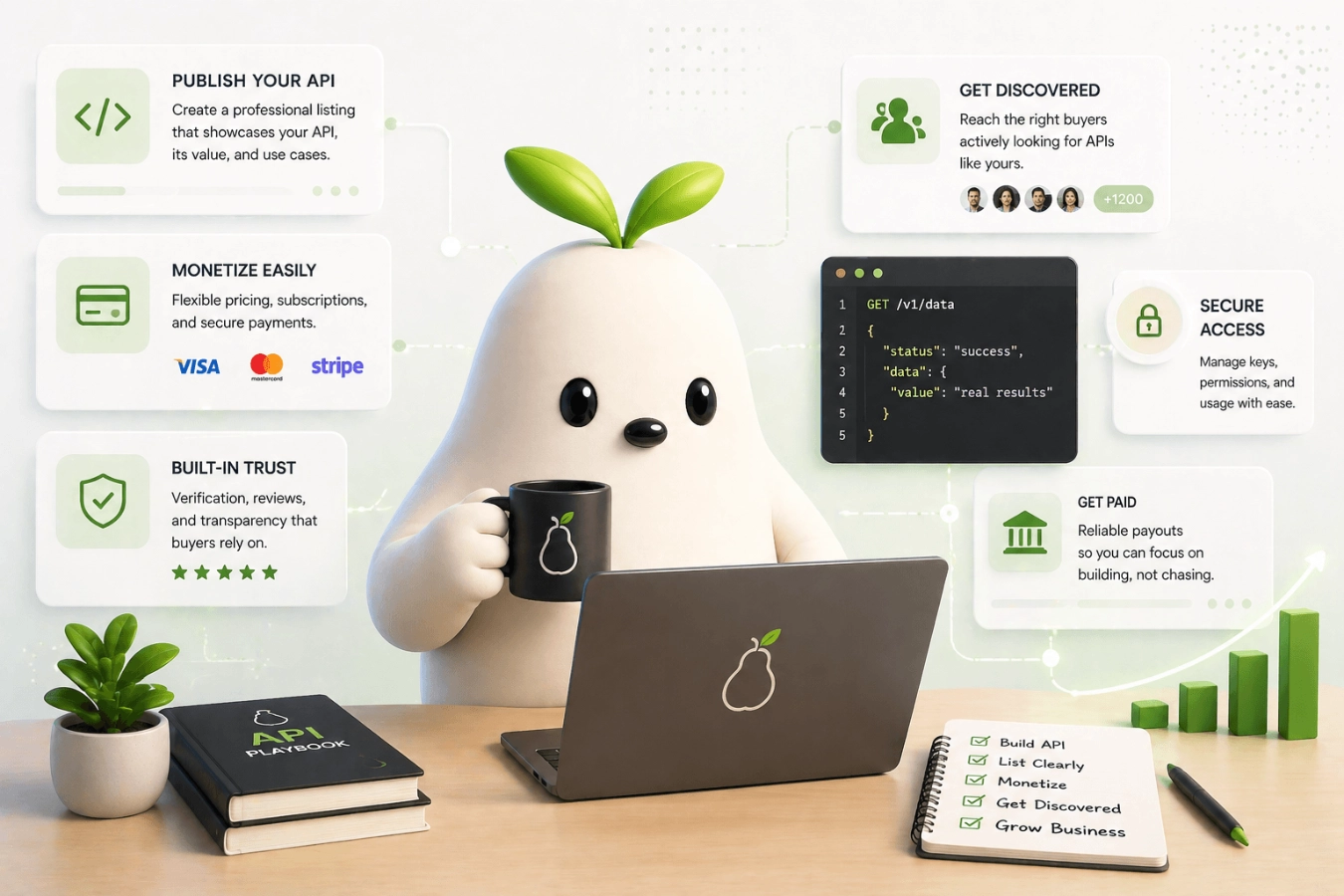
An API monetization platform or marketplace can help reduce that burden by giving you a place to publish, present, and monetize the API without rebuilding every supporting layer from scratch.
That does not remove the need for a good product. But it makes it much easier to bring that product to market.
LimitPear and the API-as-a-product model
LimitPear is built for developers who want their APIs to feel like real products, not just exposed endpoints.
The platform helps create a cleaner bridge between technical value and commercial presentation.
That matters if you want to:
- package your API more clearly
- present it with stronger trust signals
- monetize without rebuilding the full business stack
- publish in a marketplace designed for developer-facing products
For developers serious about api as a product, the value is not only in getting listed. It is in making the API easier to understand, evaluate, and buy.
Signs your API is ready to be productized
You may be closer than you think.
Your API is ready to be treated like a product if:
- it solves a repeatable problem
- more than one customer could reasonably need it
- the value can be explained clearly
- the service can be packaged into a commercial offer
- you are thinking about monetization, trust, and long-term maintenance
At that point, the next step is usually not “build more endpoints.”
It is “package what already works into something buyers can actually purchase.”
Productizing an API is a business decision, not just a technical one
That is the key mindset shift.
When you productize your API, you are making decisions about:
- market fit
- buyer expectations
- pricing logic
- marketplace presentation
- trust
- support overhead
- long-term operational sustainability
Those are product decisions.
The API still needs to perform well. But performance alone is not enough to make it a product.
Related reading
If you want to go deeper, these articles are a good next step:
- How to publish and monetize your API without building the whole business stack
- Why API monetization is still harder than it should
The bottom line
If you want to build a real API business, thinking in terms of API as a product is the right move.
That means treating the API as more than infrastructure. It means giving it packaging, pricing, positioning, trust, and a clear path to monetization.
The good news is that you do not have to build every surrounding layer alone.
If your API already solves a real problem, the next step may not be more engineering. It may be turning that API into a product buyers can understand and pay for.