
RapidAPI alternatives for developers who want a cleaner way to sell APIs
A comparison page for developers who are actively looking for another way to publish, monetize, and manage API sales.
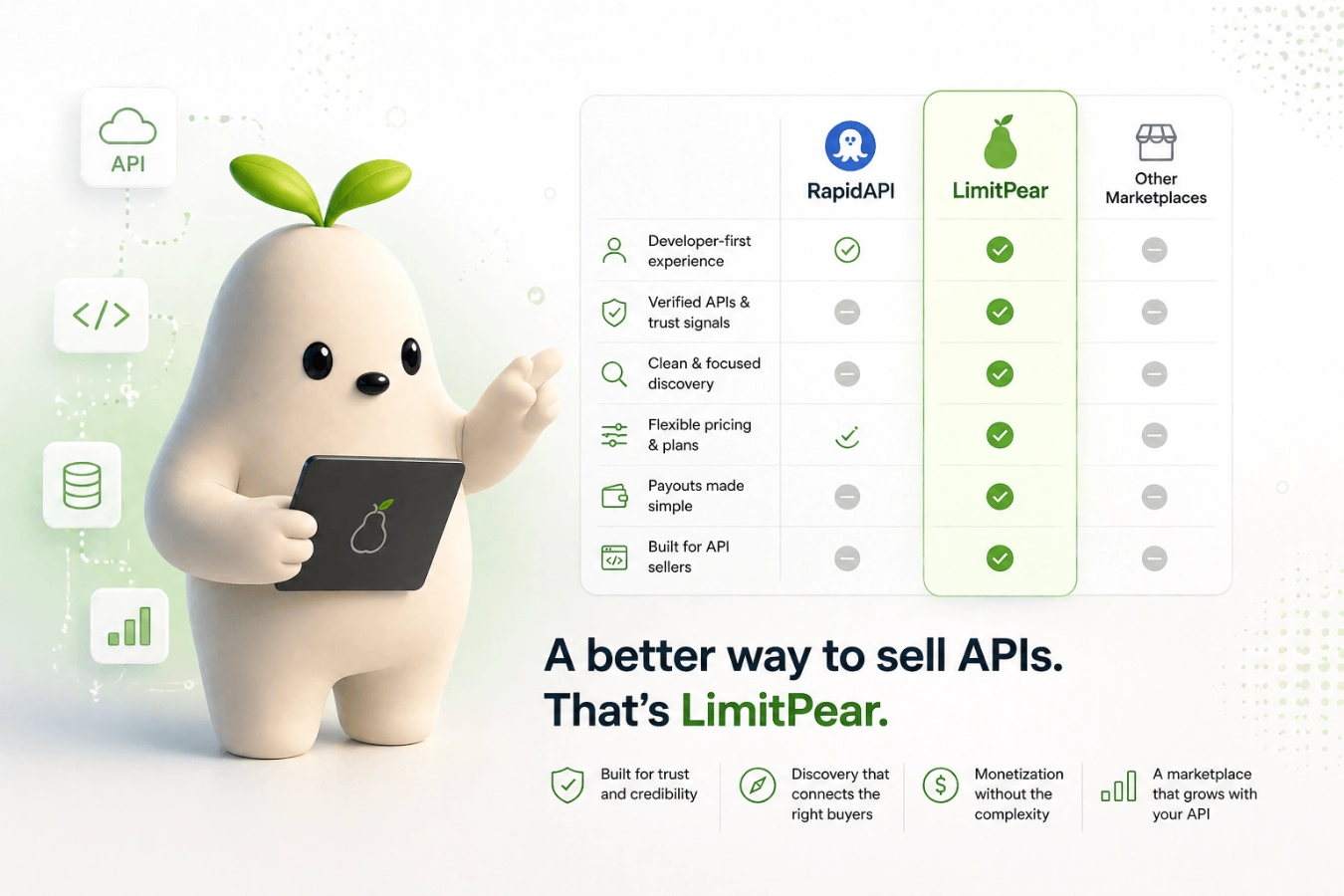
If you are searching for RapidAPI alternatives, you are probably not looking for another marketplace just to get listed. You are looking for a better way to sell an API, get discovered by the right buyers, and avoid rebuilding billing, access control, pricing, trust, and payout operations on your own.
That is usually the real problem.
For many sellers, broad API marketplaces feel useful at first because they already have traffic and a familiar category structure. But once you try to build a real business around your API, the question changes. It is no longer just “Where can I upload this?” It becomes:
- Can serious buyers trust the listing?
- Can I present my API clearly?
- Can I monetize it without adding more operational work?
- Can I get paid without creating another fragile internal system?
- Is this marketplace designed for API sellers, or am I just one more listing in a very large catalog?
If that sounds familiar, this page is for you.
Why developers start looking for a RapidAPI alternative
Most developers do not search for a RapidAPI alternative because they dislike marketplaces in general. They search because selling APIs well is harder than it looks.
You are not only shipping endpoints. You are managing:
- product positioning
- pricing and packaging
- subscriptions
- access control
- buyer trust
- support expectations
- payout logistics
- listing quality
- ongoing maintenance
That is a lot of business infrastructure for something that started as a technical product.
A broad marketplace can help with visibility, but it can also create friction for sellers who want a cleaner and more focused path to monetization. When the marketplace tries to be everything for everyone, sellers often end up needing more clarity, better trust signals, and a simpler operating model.
That is where a more focused API marketplace alternative becomes interesting.
What to look for in RapidAPI competitors
Not all RapidAPI competitors solve the same problem. Some are really discovery platforms. Some are infrastructure products. Some are closer to billing tools. Some are marketplaces in name only.
If you are comparing options as a seller, these are the questions that matter most.
1. Marketplace fit
A marketplace should help your API feel like a product, not just a technical asset buried in a directory.
Look for:
- a clean public listing
- clear pricing presentation
- strong use-case positioning
- a buyer journey that makes sense for commercial APIs
- a platform that feels active and credible
If buyers cannot quickly understand what your API does and why it is worth paying for, traffic alone will not help much.
2. Seller experience
Many developers who look for a RapidAPI alternative for sellers are really trying to reduce operational drag.
A seller-friendly marketplace should make it easier to:
- publish without unnecessary setup overhead
- manage plans and visibility
- keep your listing accurate
- avoid rebuilding the full monetization stack yourself
You should spend more time improving your API and less time stitching together everything around it.
3. Trust and verification
Trust matters on both sides of the transaction.
Buyers want to know that an API is credible before they subscribe. Sellers want to avoid being placed in an environment where serious products and low-signal listings all look the same.
A marketplace with stronger verification and clearer trust signals can make a big difference, especially for APIs with real business use cases.
4. Payout simplicity
Getting paid should not feel like a side project.
When developers compare RapidAPI alternatives, payout simplicity usually matters more than flashy positioning. If the path from subscription to payout is unclear, slow, or operationally heavy, that creates friction right where sellers need reliability most.
5. Focus
Some marketplaces optimize for maximum breadth. Others optimize for clarity.
If you are selling an API as a real product, focus can be a competitive advantage. A more selective marketplace can make discovery cleaner, positioning sharper, and buyer trust easier to build.
LimitPear as a RapidAPI alternative
LimitPear is built for developers who want a more focused way to publish and monetize APIs.
The goal is not to be the biggest catalog on the internet. The goal is to make API selling clearer for both sellers and buyers.
Here is the practical difference in approach.
| What sellers often want | LimitPear approach |
|---|---|
| A marketplace that feels credible | A more focused API marketplace model with seller and product clarity in mind |
| Better trust signals | Verification-oriented positioning that helps listings feel more reliable |
| Less operational overhead | A simpler path to publishing and monetizing without rebuilding the whole business stack |
| Clearer payout expectations | A seller experience designed around practical monetization, not just exposure |
| Better marketplace fit for commercial APIs | A platform shaped around APIs with real business use cases |
This matters because many developers do not need “more places to upload an API.” They need a marketplace that helps the API look trustworthy, commercially real, and easy to buy.
Who should consider switching
A RapidAPI alternative is worth considering if any of these sound true:
- You want to sell an API without building billing, subscriptions, payouts, and listing infrastructure from scratch.
- You want your API to be presented as a product, not just another technical entry in a large directory.
- You care about buyer trust and verification signals.
- You want a marketplace that feels more focused on seller outcomes.
- You are trying to build a durable API business, not just test casual visibility.
If you only want maximum breadth at any cost, a broad marketplace may still be the right fit for you.
But if you want a cleaner seller experience and a more focused environment, LimitPear is worth a serious look.
Switching marketplaces is not only about traffic
One mistake developers make when comparing RapidAPI competitors is focusing only on raw exposure.
Traffic matters, but it is not enough.
The better question is: what kind of marketplace environment helps your API convert, retain buyers, and feel trustworthy?
A smaller but more focused marketplace can be a better commercial fit than a larger one if:
- your listing is clearer
- your value proposition is easier to understand
- buyers trust the marketplace more
- the monetization path is simpler
- the operational burden on you is lower
That is the tradeoff many sellers are really evaluating.
If you are selling an API, clarity beats clutter
Selling APIs is already hard enough.
You still need to define the offer, explain the value, maintain uptime, support customers, and improve the product over time. If the marketplace adds confusion instead of removing it, that friction compounds quickly.
That is why so many developers end up searching for terms like:
- rapidapi alternatives
- rapidapi alternative
- rapidapi competitors
- api marketplace alternative
They are not just shopping for another logo. They are trying to find a marketplace model that fits how API businesses actually work.
Learn more before you decide
If you are still evaluating whether to switch, these guides may help:
- Why API monetization is still harder than it should
- Why we built LimitPear: a verified API marketplace for developers
- How to publish and monetize your API without building the whole business stack
The bottom line
If you are looking for RapidAPI alternatives for API sellers, the real question is not just where to list your API. It is where your API has the best chance to be understood, trusted, monetized, and maintained as a real product.
LimitPear is a strong fit for developers who want:
- a cleaner seller experience
- a more focused marketplace
- stronger trust positioning
- simpler monetization workflows
- a better path to selling APIs without rebuilding everything around them