Request an API: why demand matters in a marketplace
If a buyer cannot find what they need and has no way to ask for it, the marketplace learns nothing and providers build in the dark.
LimitPear
Founding Team
There is a simple marketplace problem that gets ignored all the time.
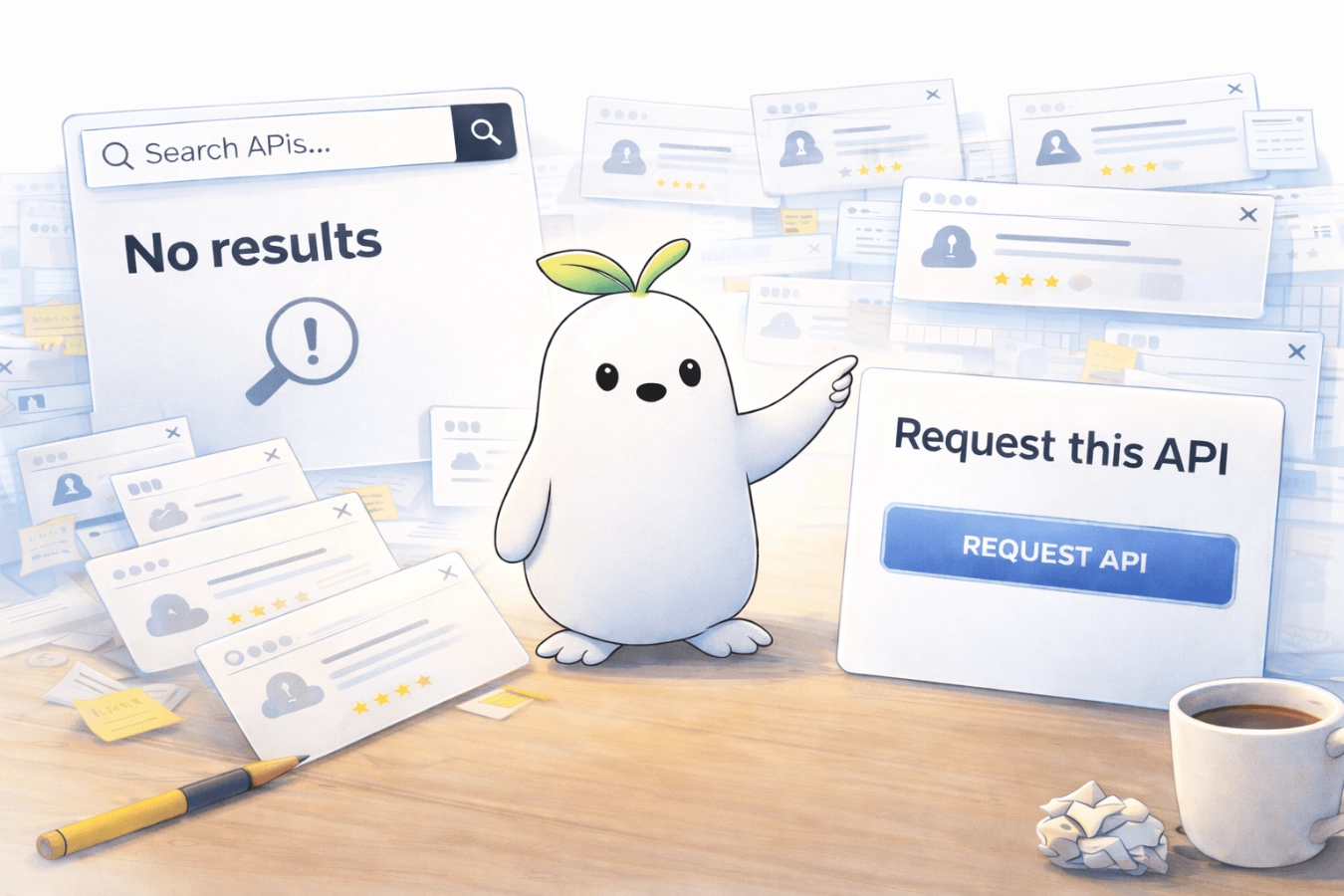
Someone shows up looking for an API. They search for it. They click around for a minute. They do not find what they need. Then they leave.
Most teams treat that like a normal miss. Just another visitor that did not convert.
I think it is worse than that.
It is a lost signal.
If you run a marketplace and you do not capture that moment, you are not just missing one user. You are missing a very clear piece of information about what people actually want.
That matters more than it sounds.
Marketplaces usually obsess over supply
When people talk about growing a marketplace, they usually start on the supply side.
How do we get more listings? How do we get more providers? How do we fill more categories?
That makes sense. If you do not have supply, there is nothing to buy.
But there is another side to this that gets treated like an afterthought: what happens when the supply is not there yet?
That moment tells you a lot.
It tells you what buyers expect to find. It tells you where your catalog is thin. It tells you what providers could build next. It tells you what categories are worth paying attention to before the data shows up in some neat dashboard three months later.
If you ignore that moment, you are mostly guessing.
A missing API is not just a missing page
This is the part I think a lot of marketplaces get wrong.
When a buyer cannot find what they need, the problem is not only that you lost one search.
The real problem is that the marketplace learned nothing from the miss.
That buyer had intent. Real intent. They were not browsing for fun. They came looking for a tool to solve something.
Maybe it was an invoice OCR API. Maybe it was a WhatsApp API. Maybe it was a phone validation API. Maybe it was something much more niche.
Whatever it was, that search had value.
If the product gives them no way to say, “this is what I needed,” then that demand disappears. The marketplace does not get better. The provider side gets no signal. The team running the platform gets no real map of what is missing.
The user leaves, and the whole thing resets.
That is a bad loop.
Good providers need demand signals too
This matters on the seller side just as much.
One of the hardest parts of building a marketplace is the two-sided problem. You need enough supply to attract demand, and enough demand to make supply worth listing in the first place.
That is obvious. What is less obvious is how often providers are left building with weak signals.
A lot of creators are not asking, “Can I build something?”
They are asking:
- Will anyone want this?
- Is there demand for this category?
- Am I too early?
- Is this worth maintaining?
That uncertainty kills good projects before they even get listed.
A request system helps with that.
It does not magically solve supply density, but it gives providers something much better than vibes. It gives them direct evidence of what people are already trying to find.
That is useful.
It helps a provider decide what to build. It helps a marketplace decide what categories need attention. It helps both sides stop making decisions in the dark.
More listings do not fix this by themselves
There is a lazy version of marketplace thinking that says the answer is always more supply.
Just add more APIs. Just get more providers. Just keep filling the catalog.
But supply without structure is noisy. And supply without demand visibility is inefficient.
You can end up growing a catalog while still missing what buyers actually want.
That is one of the reasons large marketplaces often feel worse as they get bigger. The problem is not only quality. It is also weak feedback loops.
If the marketplace only learns from what is already listed, then it is always looking backward.
A request flow changes that.
It gives you a way to see forward.
Not perfectly. Not all at once. But enough to learn faster than a marketplace that only waits for providers to guess correctly.
A request flow is not a side feature
This is the part I care about most.
I do not think “request an API” should be treated like some little extra page in the footer.
It is part of the product.
It is part of how a marketplace listens.
For buyers, it creates a path other than leaving.
That matters because dead ends are expensive. If someone cannot find what they need, the platform should not just shrug and hope they come back later. It should give them a way to tell you what is missing.
For providers, it creates visibility into demand that they would not otherwise have.
That matters because good providers do not just want traffic. They want confidence that they are building something the market is already asking for.
For the marketplace itself, it creates a better learning loop.
That matters because without demand capture, roadmap decisions start looking like this:
- maybe this category matters
- maybe buyers want this
- maybe providers would care
That is not good enough.
Why we care about this at LimitPear
At LimitPear, we think marketplaces should not just be catalogs. They should get smarter as people use them.
That means supply matters. Trust matters. Verification matters.
But demand matters too.
If someone comes to the platform, cannot find the API they need, and has no way to tell us, then we are throwing away useful information.
That is why /request exists.
Not because forms are exciting. Not because “request an API” sounds good on a feature list.
It exists because missing demand should not disappear.
If enough people are looking for the same thing, that should become visible. If providers are deciding what to build next, they should not have to guess alone. If the marketplace is serious about becoming more useful over time, it has to listen when supply is missing, not only when supply is already there.
That is the bigger point.
Requests are not just requests.
They are one of the clearest signals a marketplace can get.
If you are looking for an API and cannot find it, request it here.
Build with LimitPear
Turn demand into the next API opportunity
Explore the marketplace, request what is missing, and use the blog as a bridge between ideas and real developer demand.